Asteroid Vesta
An example of my research activities can be found in the recent work on the cratering history of the main belt asteroid Vesta in the framework of NASA Dawn mission. Images acquired during the early stages of the mission were used to construct a preliminary catalog of craters larger than about 4 km in diameter. The overall distribution of craters can be seen in the following "circles on Vesta" image:
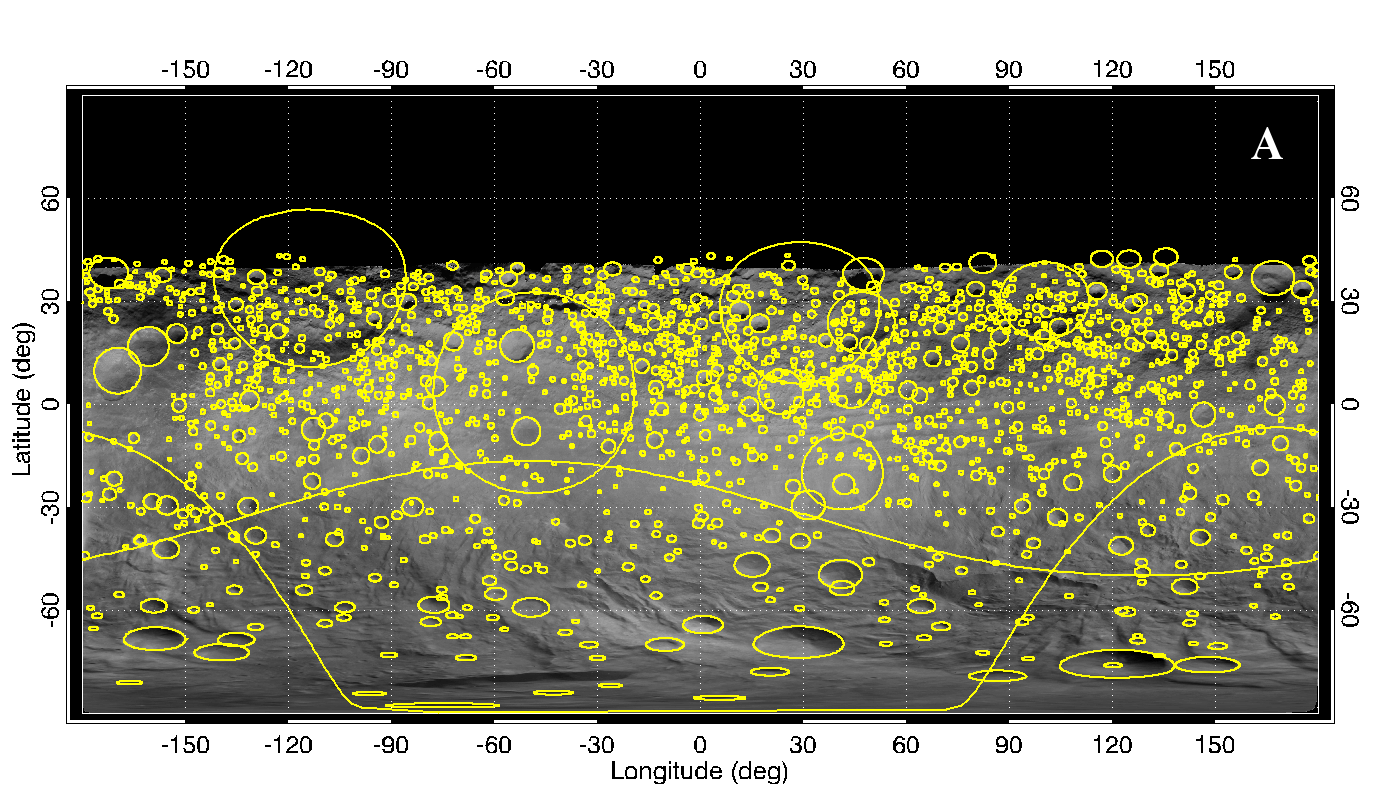
Figure 1. Craters distribution on Vesta. Each yellow circle corresponds to an impact crater. This image contains 1872 craters. Note the two large craters that wrap around the south pole: they are called Rheasilvia and Veneneia and they both measure about 500 km across (Figure after Marchi et al, Science, 2012). The spatial resolution of the map is ~300 meters per pixel. Click here for the full paper.
Since the publication of this work, Dawn has completed its operations at Vesta. In doing so, a better image resolution was achieved (down to 20 meters per pixel) and also better coverage of the northern hemisphere (in shadow in Figure 1).
Besides the (remarkable!) fact that Vesta is one of the few asteroids ever reached by a spacecraft, Vesta is a really unique body for many other reasons. In particular, I find it absolutely mind-blowing that we do have chips of Vesta in our meteorite collections. This is truly a striking feature. Among the ~500,000 kg of extraterrestrial material in our labs, we have only established genetic links for three objects so far: Vesta, the Moon and Mars. Among them, Vesta is the farthest from us: ~1.1 astronomical units (~164,557,657 km) at the closest. Here is a picture of a chip from Vesta's deeper crust (a rock type called diogenite, also common on Earth) sitting on my desk:
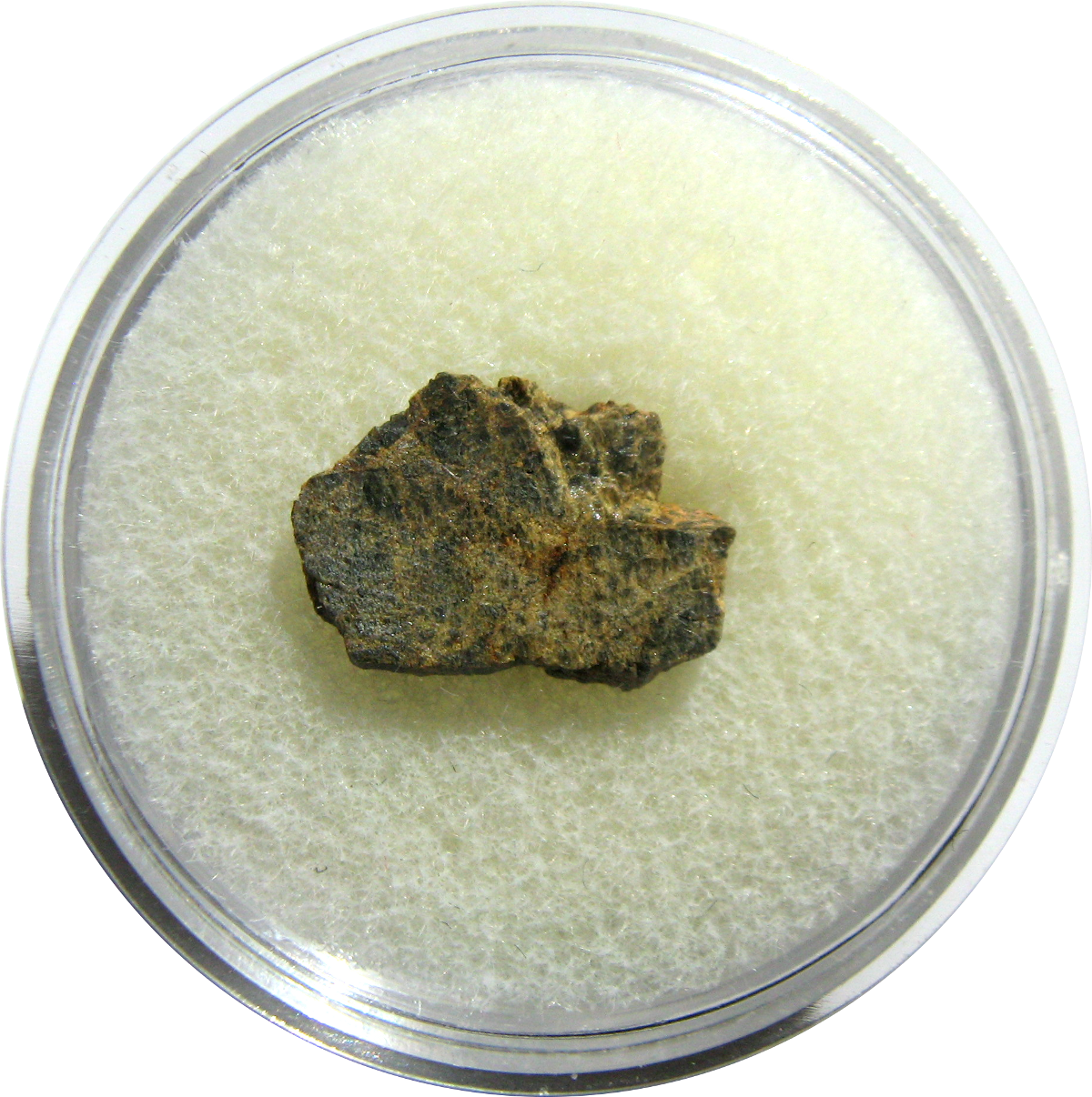
Figure 2. Diogenite "Tatahouine" found in Tunisia. The parent meteorite fell on June 27, 1931 near the town Foum Tatahouine. Several fragments (for a total of ~13 kg) were collected afterward. The meteorite is also known as "Green Meteorite" given its greenish color. The fragment shown in this picture is about 1 cm wide. In addition to diogenites, eucrite and howardite (the latter is a mixture of the first two) meteorites are also thought to come from Vesta.
Thanks to Dawn, we now have a better understanding of Vesta and its link to the howardite, eucrite and diogenite meteorites. To me, one of the most intriguing outcomes of Dawn observations is that they clearly disclosed a body with two distinct "faces". There is the "young" face shown by the hilly and rugged southern hemisphere, while the northern hemisphere appears to be much "older" given its smooth and gently sloped surface as a result of eons of impact cratering. There is the "dark" face expressed by localized spot of low albedo (< 20%) opposed to the "bright" face where the albedo can be as high as 40%. Also, the composition is rather heterogeneous, from diogenitic-rich to eucritic-rich material.
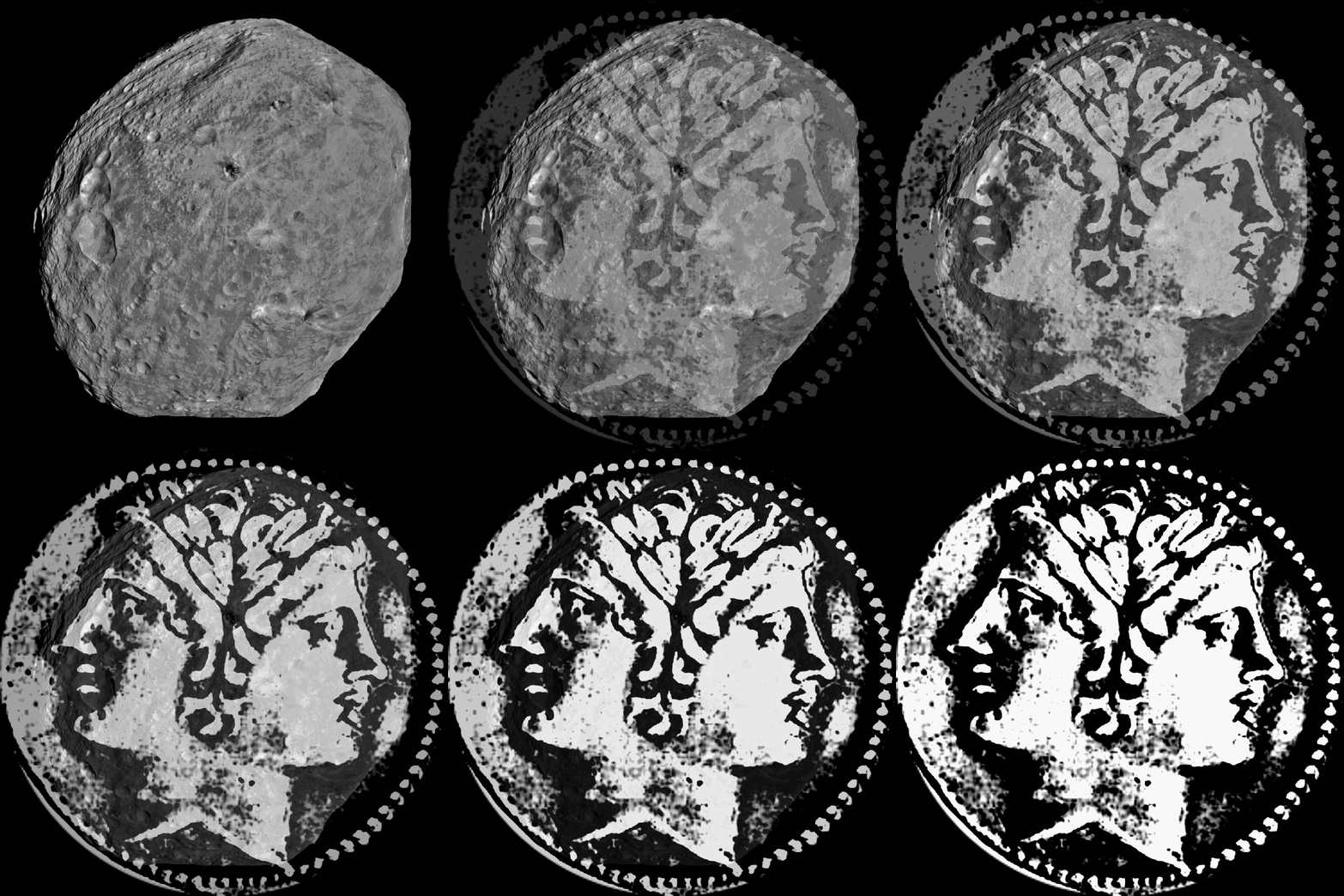
Figure 3. Animation showing the two faces of Vesta. Well, this is not exactly what Dawn saw at Vesta, but it helps visualizing the two faces of Vesta (the faces are a representation of the Roman god Janus Bifrons on a coin, ~200 BCE).