The shaping of the terrestrial planets
The formation of the Solar System began when interstellar clouds of gas and dust started to coalesce. As gravity pulled these elements together, they formed the central star—our Sun—which was enveloped by a flattened disk of consolidating materials. From this solar nebula, our terrestrial planets (Mercury, Venus, Earth, and Mars) formed as smaller rocky objects gradually accumulated, or accreted, into larger planetesimals, and eventually into massive protoplanets.
During the final stages of this process, late planetesimal impacts made critical contributions to the planetary bodies. The Earth, for example, was likely the last terrestrial planet to fully form, bringing together about 99% of its final mass within approximately 60 to 100 million years after the first solids began consolidating.
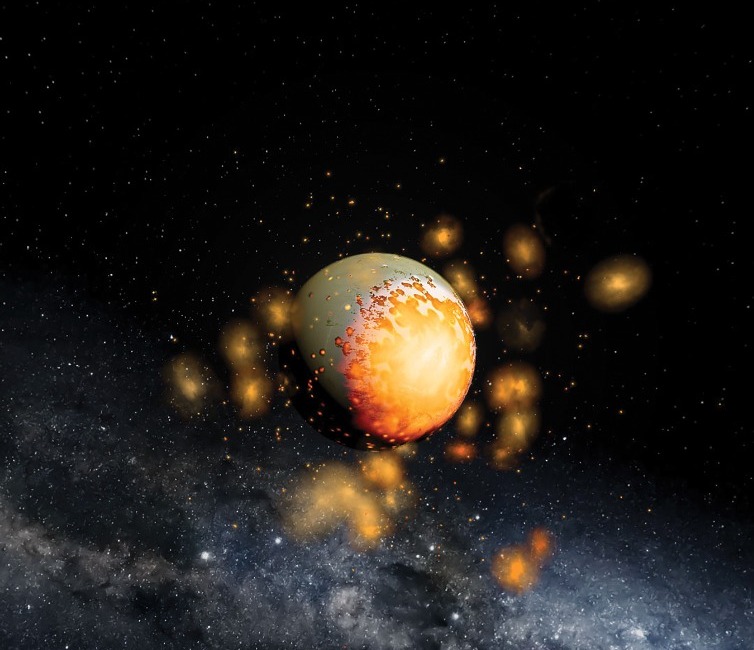
Figure 1. An artistic rendering of early planetary bombardment.
Late accretion—representing just the final 1% of planetary growth—plays a disproportionate role in controlling the long-term evolution of the Earth and other terrestrial planets. Differences in the late accretion history of these inner planets provide a clear rationale for interpreting their distinct physical properties. Through the use of large-scale impact simulations, recent scientific progress has successfully constrained the history of these late accretions, shedding light on how late-stage impacts directly shaped the subsequent interior, crustal, and atmospheric evolution of each rocky planet.
The mechanisms of plate tectonics, atmospheric composition, and the water inventories of Venus and Earth appear tied to specific late accretion events. Similarly, the striking geological surface variability of Mars and the unusually high metal-to-silicate mass ratio of Mercury are also directly associated with late, large-scale planetary impacts.
This research was published as a Nature Review article in 2025 (here).