Vesta's Bombardment: Hot and Heavy
Fragments from asteroids provide a unique opportunity to study the processes that shaped the early solar system. Some of these rocks, found on the Earth as meteorites, reveal signs of impact processes on their parent bodies, recorded as tiny variations in the amount of radiogenic elements, like the noble gas Argon (see Figure 1). Particularly intriguing are the signatures found in many chondritic meteorites (e.g. the ordinary chondrites enriched in iron), and in a major clan of achondrites (e.g. the howardites, eucrites and diogenites; originated from asteroid Vesta).
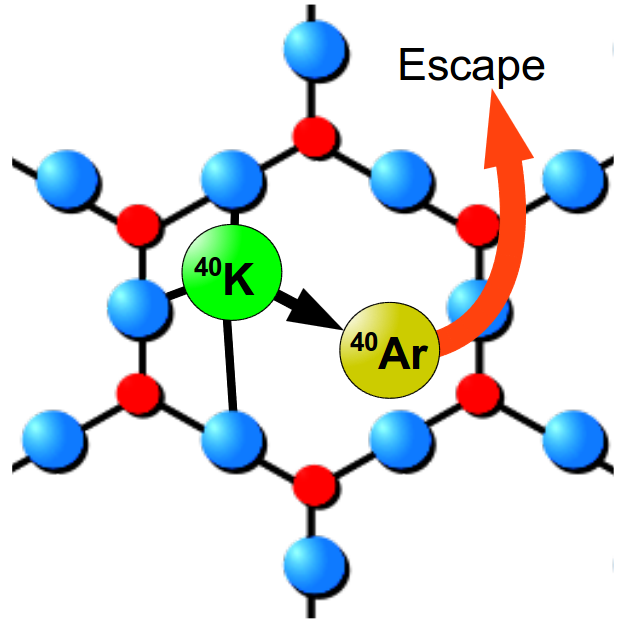
Figure 1. Potassium and Argon. The noble gas Argon (Ar) entrapped in meteorites as a result of radioactive decay of Potassium (K) is widely used to constrain the time when major impact processes took place on the meteorites' parent bodies. Impacts produce heating that trigger Ar release from the lattice. Thus, the relative abundance of Ar (highly volatile) to K (less volatile) tells us the elapsed time since the last major impact. These ages are commonly called impact-reset ages.
These rocks show signs of multiple impacts that took place about 4 billion years ago, during the so-called "late heavy bombardment" or "lunar cataclysm", a characteristic also shared by many lunar rocks. Clearly, the Moon, Vesta and other meteorite parent bodies do not share similar collisional histories. In fact, objects like Vesta are surrounded by a large reservoir of asteroids, the Main Belt, confined between the orbits of Mars and Jupiter. These objects have orbits that often intersect one with each other, implying a high collisional rate.
On the other hand, the Moon resides in a relatively quieter region of the solar system, where collisions with interplanetary rocky bodies are much more uncommon. Thus, how is it that lunar rocks and several asteroidal meteorites share strikingly similar collisional patterns? Is that a mere coincidence or, rather, is it telling us something profound? While this puzzling coincidence has long been recognized by several researchers, a satisfactory answer to this conundrum has only been suggested in a recent multidisciplinary work.
Researchers have linked the lunar and asteroidal datasets and found that the same population of projectiles responsible for making craters and basins on the Moon around 4 billion years ago were also hitting Vesta at very high velocities, enough to leave behind a number of telltale, impact-related ages (see Figure 2).
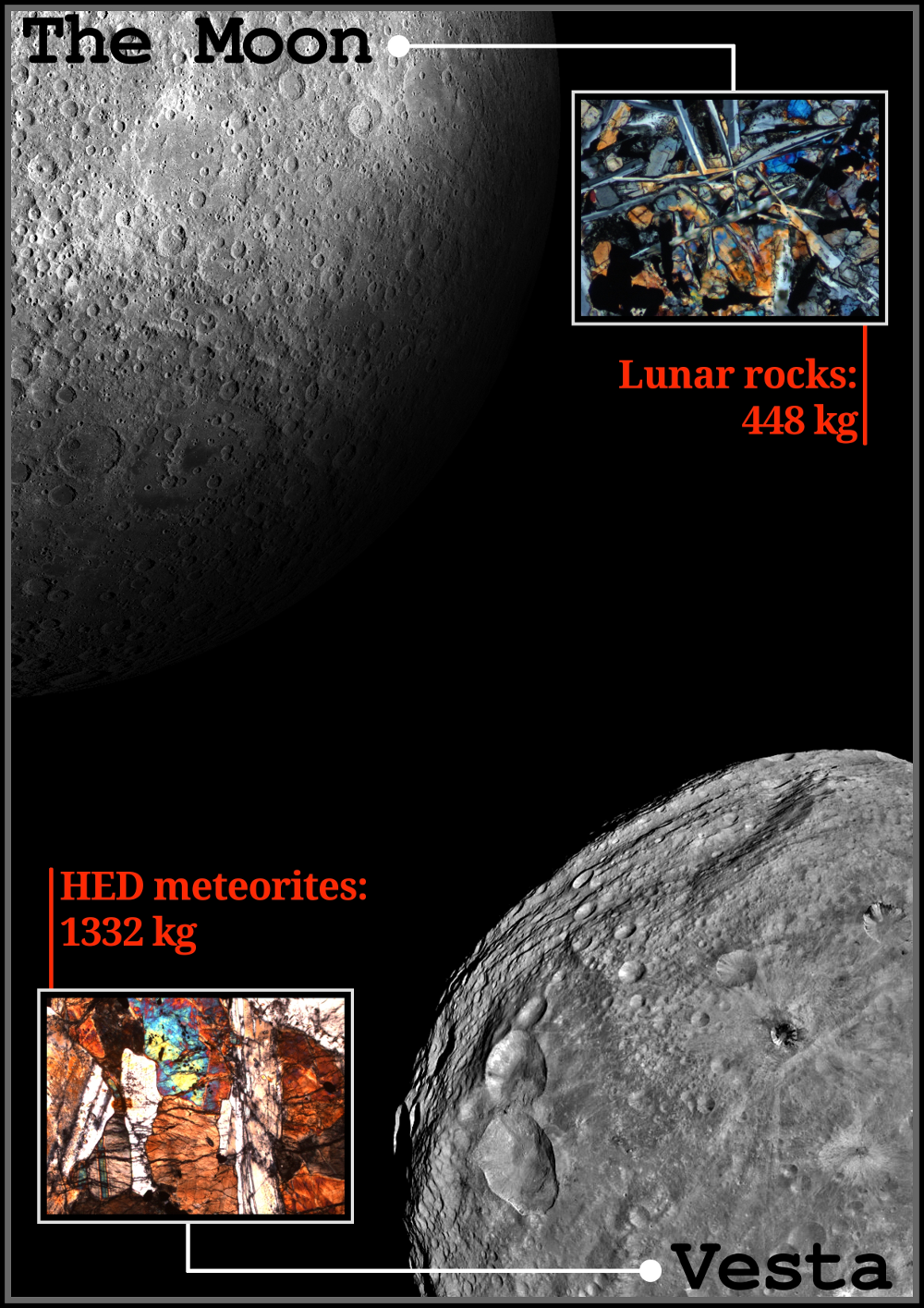
Figure 2. Lunar and Vestan samples. The new research demonstrates how to use howardite, eucrite and diogenite (HED) meteorites, that originated from Vesta, to study the lunar cataclysm. Interestingly, the total mass of lunar rocks stored in our laboratories is approximately 448 kg. For comparison, HEDs sum up to 1332 kg. Thus, thanks to the new interpretation of HEDs impact-reset ages, this new work expanded by about three times the total mass available to study the lunar cataclysm.
This novel interpretation of the howardites and eucrites was augmented by recent close-in observations of Vesta's surface by NASA's Dawn spacecraft. In addition, the team used the latest dynamical models of early main belt evolution to discover the likely source of these high-velocity impactors, finding that the population of projectiles that hit Vesta had orbits that also enabled some objects to strike the Moon at high speeds.
The findings support the theory that the repositioning of gas giant planets like Jupiter and Saturn from their original orbits to their current location destabilized portions of the asteroid belt and triggered a solar system-wide bombardment of asteroids billions of years ago, the lunar cataclysm. The research also provides new constraints on the start and duration of the lunar cataclysm, and demonstrates that the cataclysm was an event that affected not only the inner solar system planets, but the asteroid belt as well.
The paper, published on April 2013 in Nature Geoscience, can be found here.
I can tell you that doing this work was a lot of fun!