Mercury the Younger
Mercury is a fascinating world. Among the terrestrial planets it is the closest to the Sun and, for this reason, its study has always been a challenge: both for ground-based and spacecraft observations. Mercury was observed at close range for the first time by the spacecraft Mariner 10 in the 70s. After more than 30 years of loneliness, in 2011 the MESSENGER (MErcury Surface, Space ENvironment, GEochemistry and Ranging) mission was inserted into orbit around Mercury, enabling planetary scientists to perform unprecedented analyses of its surface, tenuous atmosphere, and interior.
My interests in Mercury reflect some of my latest work about the Moon and Vesta. Thanks to these studies, I was able to provide new evidence in favor of the so-called "late heavy bombardment" (a period of intense bombardment in the inner solar system that occurred about 4 billion years ago). Therefore, I was eager to study the effects -if any- of this heavy bombardment on Mercury's surface. In collaboration with the Geology Discipline Group of the MESSENGER team, I performed an analysis of the oldest visible terrains on Mercury (namely, those with the highest crater density). Then, I applied a new chronology that I helped to develop, which allowed us to convert the crater density measured on a given terrain into its absolute age. The results were puzzling. To my great surprise, the oldest terrains on Mercury date around 4.0-4.1 billion years ago (see Figure 1):
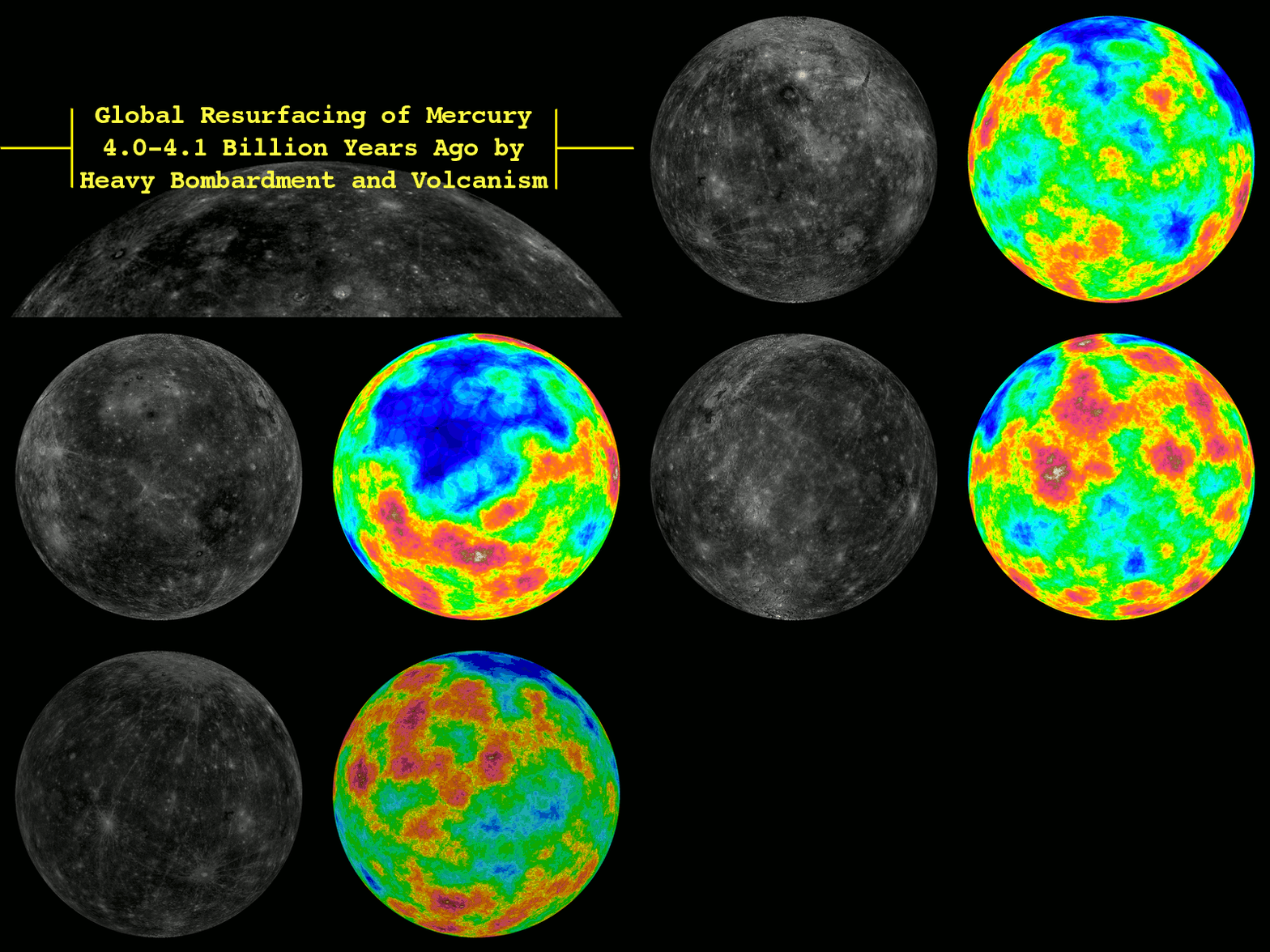
Figure 1. The animation compares the actual surface of Mercury, as seen by MESSENGER (left-hand panel: obtained using a publicly available mosaic of Mercury found here), to the crater areal density (right-hand panel: number of craters larger than 25 km averaged over neighbor regions of 300 km in radius). The crater density is shown in color, ranging from dark blue (minimum) to white (maximum).
One may ask: so, what's the big deal? Well, first of all, this finding implies that the first 400-500 million years of Mercury's history (which is thought to have formed about 4.5 billion years ago, as is supposed for the Earth and Moon) are lost. In other words, something tremendous must have happened early in Mercury's history to erase its surface. What could that have been? Hard to say, given that the most ancient surface is lost (!), and with it also the traces of what may have caused the resurfacing. However, additional indirect information indicated that voluminous volcanism took place on Mercury, and perhaps it was strong enough to wipe out its surface. Our work also suggests that this erasure could have been aided by the heavy bombardment itself.
This research was published in the July 4th 2013 issue of Nature magazine (here).