Ancient Earth: Fire from above, fire from below
Researchers debate what the early Earth's surface looked like, and when life first originated on Earth. Such quests are inextricably linked to the environmental conditions after the Earth was fully formed, about 4.5 billion years ago, and how the surface evolved over time.
Some researchers argue that the early Earth was an inhabitable place being continuously hit by asteroids and comets left over from planet formation. Other researchers, however, have a radically different opinion. According to them, the early Earth surface is pictured with abundant liquid water soon after its formation, perhaps as early as 4.4 billion years ago. Water is a key element for life, thus the early Earth might have been a tranquil abode for life to spring.
Interestingly, the oldest evidence of life is found in rocks about 4 billion years old. A similar age is also found for the oldest known rocks. As a result, the first 500 million years (that is, from 4 to 4.5 billion years ago) of Earth's history eludes us. Was the Earth inhabitable during this epoch? Is the lack of an ancient geological record a by-product of forces that shape today's Earth, such as plate tectonics? These are fundamental questions to understand how our own planet evolved and, ultimately, how we came to be.
In a paper recently published in Nature, we argue that the most likely scenario was mid-way between the Earth being an inhospitable orb and a tranquil abode (see Figure 1). Asteroid impacts were indeed numerous during the first 500 million years of Earth's evolution. They certainly brought widespread destruction on the surface. For instance, we compute that more than 10,000 asteroids larger than 10 km collided with the Earth, a size comparable with the asteroid that wiped out the dinosaurs (along with about three-quarters of plant and animal species!) about 66 million years ago. The effects of these collisions, however, were tiny, when compared with larger ones. We compute that the Earth was hit by about 200 objects larger than 100 km in diameter. Each of these collisions was at least 1,000 times more energetic than the one responsible for the extinction of dinosaurs.
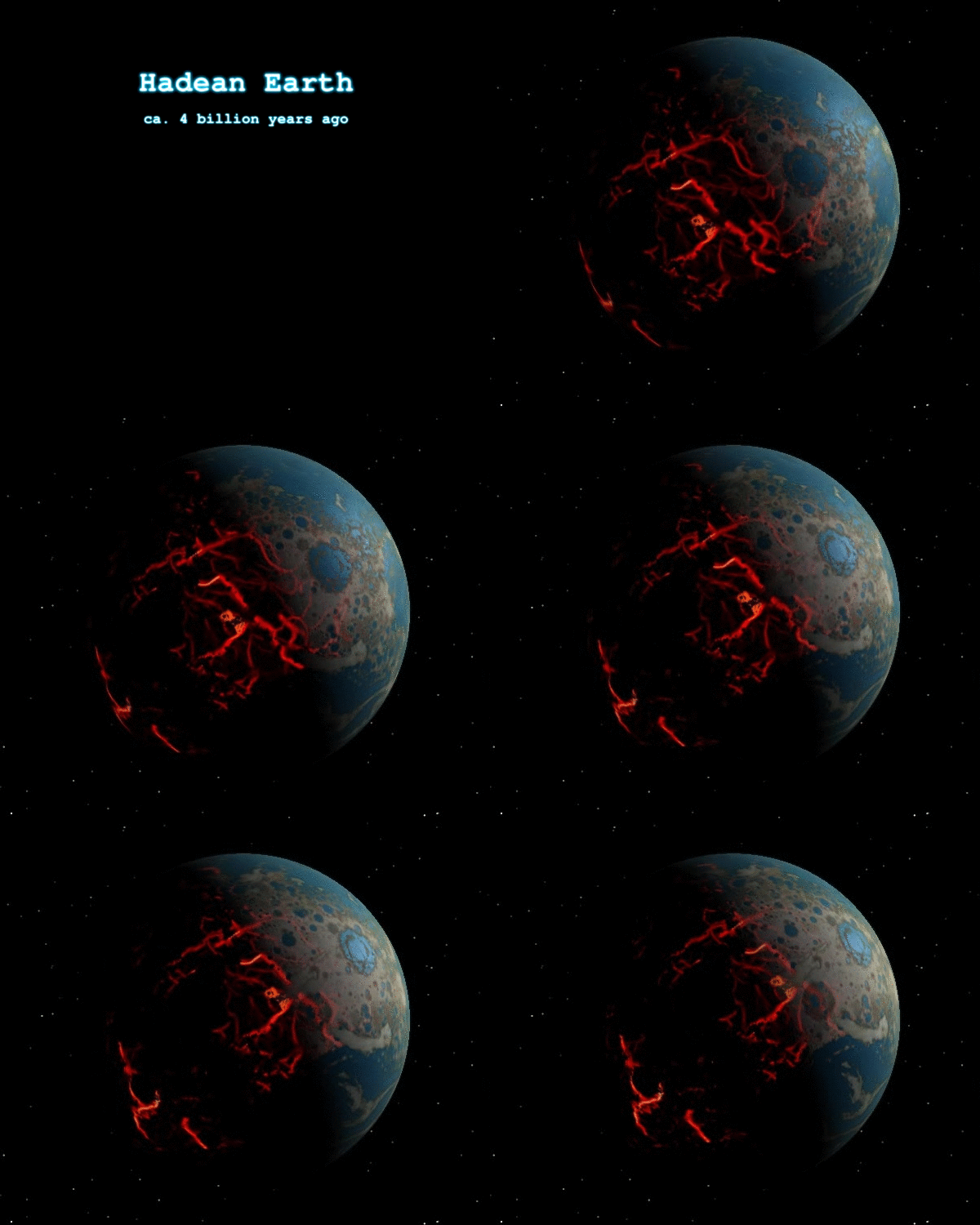
Figure 1. An artistic conception of the early Earth-Moon system. The Earth is pictured as surface pummeled by large impacts, resulting in extrusion of impact-generated deep-seated magma onto the surface. At the same time, distal portion of the surface could have retained liquid water. The Moon is pictured as a dry, heavily cratered body. The Moon is far less geologically active than the Earth, and its older surface and rocks have been used to calibrate our bombardment model (click on picture for a higher resolution version of the movie).
We compute that these large impacts would have melted large volumes of the Earth's crust and mantle. These volumes of deep-seated melt were unstable due to the various forces acting on them, and they might have poured out on the surface burying large surface areas under a thick layer of molten rocks (see Figure 2). One could picture this process as a gigantic volcanic eruption (a good analogy for this process, although not due to impacts, may be represented by the so-called large igneous provinces currently found in various locations on Earth).
Any existing ecosystems were being roasted from above and from below!
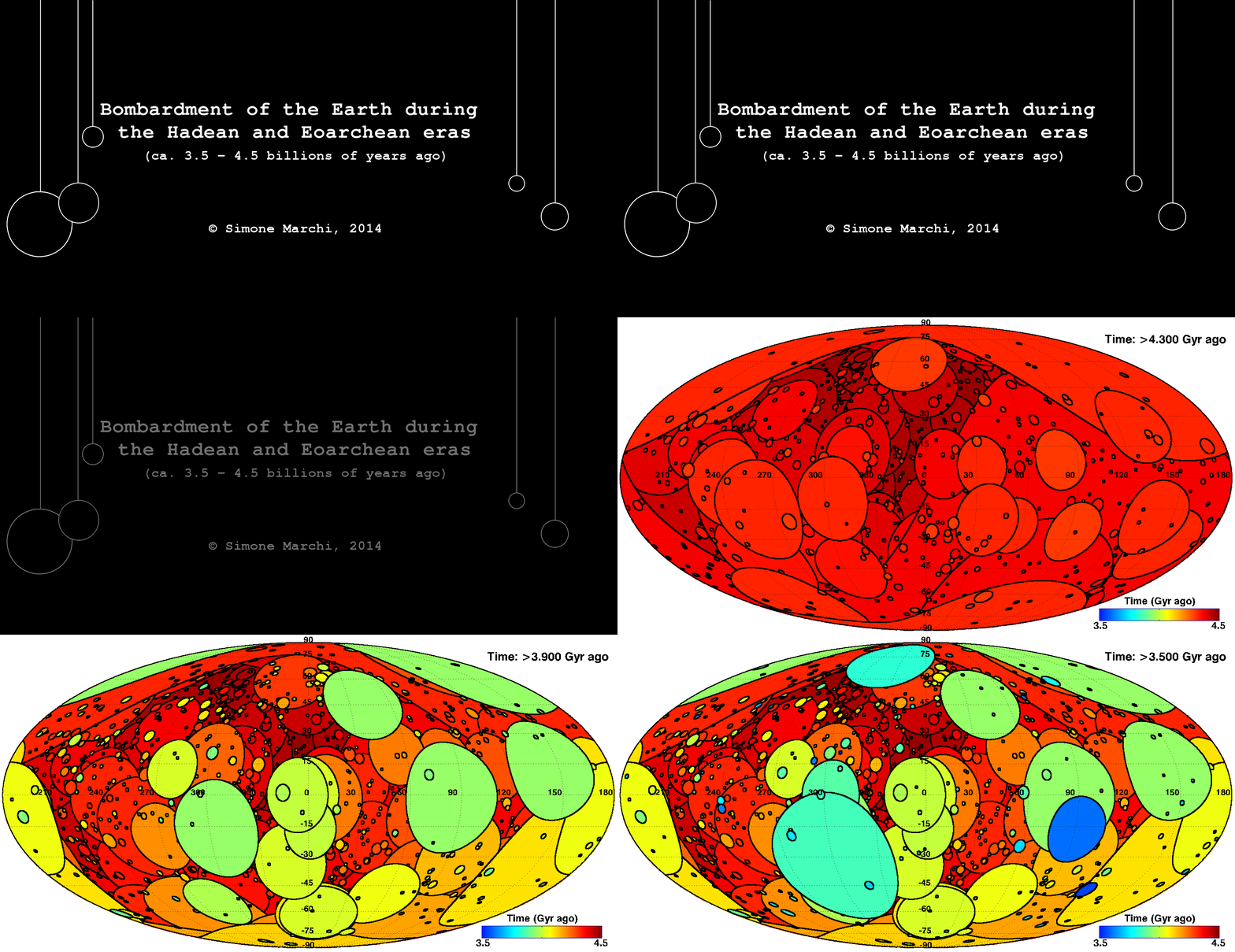
Figure 2. An animation showing the effects of bombardment on the early Earth. Each circle represents the area highly processed by an impact. The diameters of the circles correspond to the final size of the craters for impactors smaller than 100 km in diameter, while for larger impactors it corresponds to the size of the region buried by impact-generated melt, as described in the text. Color coding indicates the timing of the impacts. The smallest impactors considered have a diameter of 15 km.
Despite this immense disruption, the effects of collisions including the large ones were mostly localized. There were at any given time ample areas where water could have existed. It is therefore conceivable that early life could have survived by migrating through stable niches during the Hadean. Whether these stable areas were suitable for life depends upon the physical and chemical conditions existing in these niches, which are not known.
Our model also predicts that the Earth was hit by 2-4 asteroids larger than 1000 km. These collisions were so energetic that they are thought to result in global sterilization – pre-existing life would have been wiped out. We used our model to track the timing of such collisions among a large number of simulations (we cannot reconstruct uniquely the bombardment of the Earth, thus a statistical approach is fitting). Interestingly, we find that the mean time for the last sterilization event is about 4.4 billion years ago. Thus, any life existing prior to this time would have likely been annihilated – starting all over again at a later time.
The fundamental question of when life emerged on Earth continues to elude us. More work is needed to address in detail the consequences for the environment during the early bombardment. Our work is a step forward toward that goal. Stay tuned for future developments.
This research was published in the July 30th 2014 issue of Nature magazine (here).