Ancient Earth Atmosphere: collisions and the faint young Sun paradox
I have discussed in a previous post (here) how the early Earth's evolution was presumably largely influenced by the myriad of collisions with debris leftover from the planetary formation process. Excavation, mixing, and melting of terrestrial rocks are some of the most obvious outcomes of these collisions. The largest impacts are also associated with more profound and enduring effects to the overall tectonic regime of the Earth, and its thin atmosphere. Here we focus on the latter.
Collisions certainly produce havoc, whose effects in the case of large impactors – 100s km in diameter or larger – can be global. The largest, most energetic collisions could also have resulted in complete vaporization of the oceans and production of a hot, transient silicate-rich atmosphere. As the atmosphere cools off, molten rock droplets precipitate down followed by heavy rains. The picture of an incandescent sky with pouring hot rock is rather hellish. It is anticipated, however, that over a time scale of thousands of years, the Earth will restore to pre-impact surface conditions.
Collisions may also have a more enduring effect on the atmosphere. This is associated with the production of impact-generated volumes of molten rocks. For impactors larger than ~100 km or so, most of the molten rocks are derived from the Earth's mantle. These volumes spread onto the surface encompassing large areas, creating literally lava lakes. This is somewhat analogous to the emplacement of the so-called large igneous provinces, or on a much smaller scale, to volcanic lava eruptions. As a rule of thumb, a 100 km impactor is estimated to produce a lava lake with a diameter of 1,000-2,000 km. Certainly, the spreading of large volumes of lava produced also temporarily hellish conditions, at least locally.
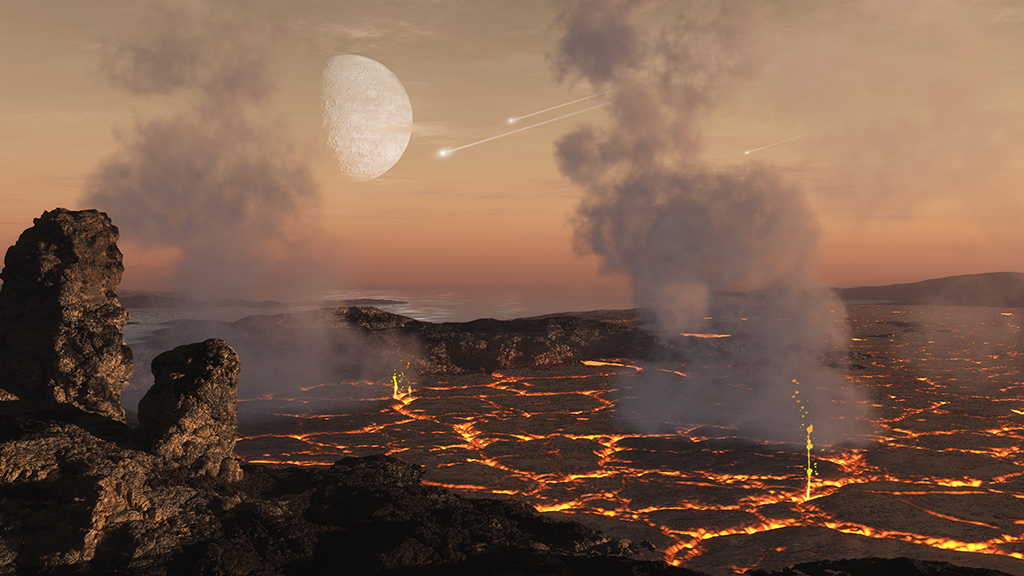
Figure 1. An artistic conception of the Hadean Earth. Huge, impact-generated lava lakes coexisted with surface liquid water, under a thick greenhouse atmosphere sustained by lava outgassing (credit: SwRI/Simone Marchi, Dan Durda).
There is, however, an interesting twist to the story above. Molten rocks release dissolved volatiles such as carbon dioxide, water, etc. These gases have the potential to alter the atmospheric composition and, thus, have consequences for the environment. It is well documented that large volumes of carbon dioxide released by volcanic eruptions in recent times may have appreciably altered the surface temperature. Similarly, outgassing of impact generated lava lakes could have released significant amount of carbon dioxide and other greenhouse gases (Figure 2).
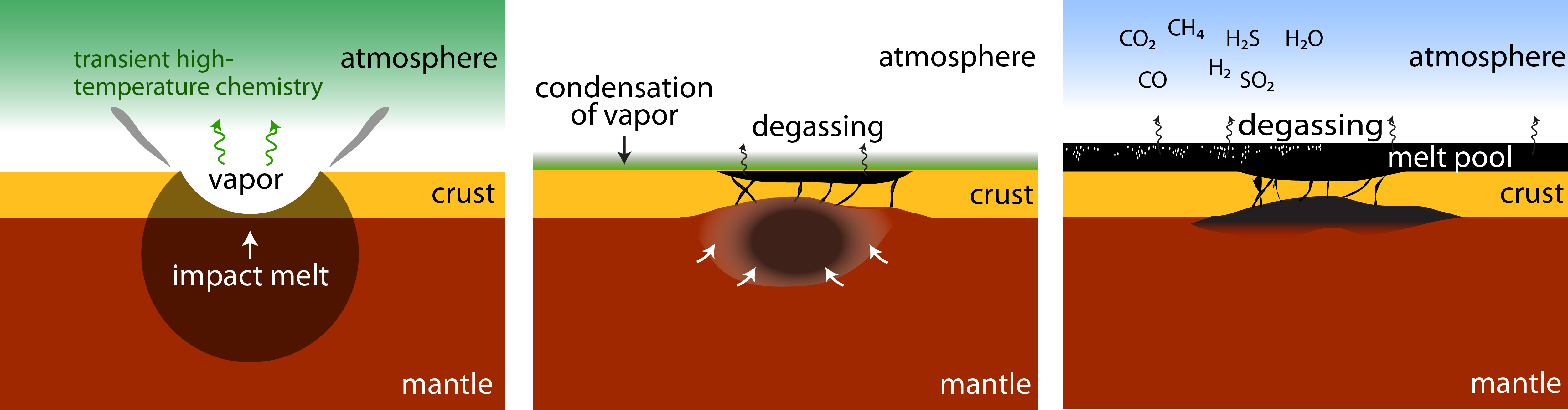
Figure 2. A large impact creates a transient high temperature atmosphere (left panel). Within a thousand years, the atmosphere condenses (middle panel), while deep-seated, impact-generated melt spreads across the surface (right panel). The model shows how pools of lava could release gases and create a greenhouse effect that warmed the planet.
Interestingly, the environmental effects of the released gases could last much longer than the post-impact, hot transient phase discussed above. Also, the cumulative release from multiple impacts build up high concentrations of atmospheric greenhouse gases. An increased budget of atmospheric carbon dioxide implies higher surface temperatures. While we do not have precise knowledge of the surface conditions during the Hadean and Archean (3.5-4.5 billion years ago), it has been postulated that the Earth could have been in a frozen state due to reduced solar luminosity at visible wavelengths. This is known as the famous “faint young Sun paradox”, introduced by Carl Sagan and others in the 70's. However, ancient zircon crystals in sedimentary rocks provide evidence that our planet had liquid oceans, at least intermittently, during this earliest period. This would imply the presence of elevated atmospheric levels of greenhouse gases, such as carbon dioxide and methane, to counterbalance the weak light from the infant Sun and sustain liquid water.
With the aid of numerical simulations we have shown that the release of greenhouse gases such as carbon dioxide may have been sufficient to temporarily offset weaker insolation from the faint young Sun. Depending on the timescale for atmospheric carbon dioxide drawdown, impact-induced outgassing could have sustained clement surface conditions episodically (1–10 million years) or for a protracted time (100s millions of years).
Thus, the picture emerging is one in which after the transient havoc of a hot, silicate-rich atmosphere has passed, impact-generated melt outgassing could have substantially altered surface conditions. The bombardment also redistributed, or delivered to the surface and subsurface, carbon and sulfur, both important elements for life with important implications for oceanic pH and early metabolic chemistry. Our work supports a view of the early Earth in which impacts were responsible for environmental catastrophes (local or global, depending on the impactor size), followed by more benevolent global effects (Figure 3).
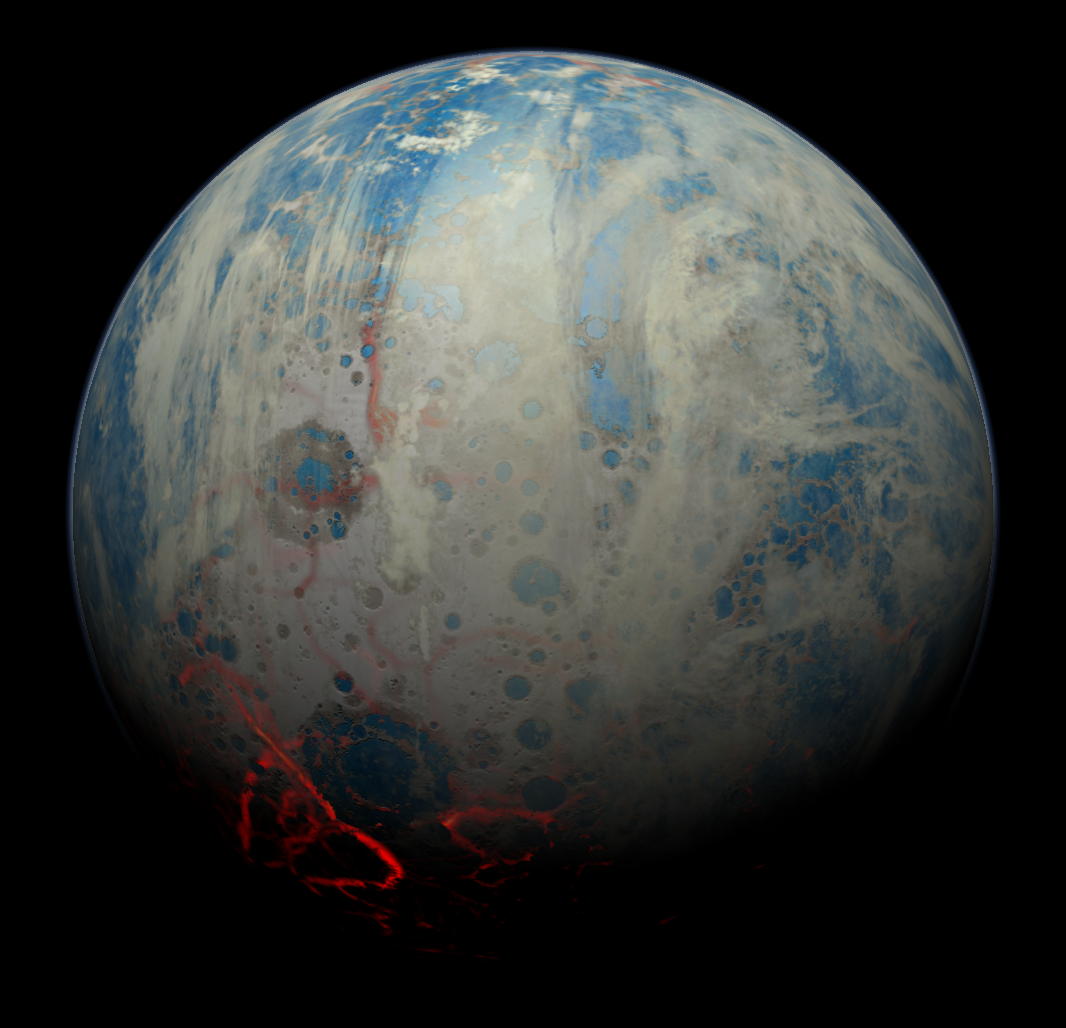
Figure 3. This artistic illustration shows how the early Earth might have looked under bombardment, with circular impact features dotting the daylight side, while hot lava glows on the night side. A thick, yellowish hazy atmosphere is also present.
This research was published in the September 1st 2016 issue of Earth and Planetary Science Letters magazine (here).