Dwarf planet Ceres, a treasure chest for planetary science
Ceres, the Roman goddess of agriculture and harvests. Ceres, the modern dwarf planet, which thanks to the Dawn spacecraft is returning a harvest of discoveries. It all began on January 1st 1801 when astronomer and priest Giuseppe Piazzi spotted from the Royal Observatory of Palermo, Sicily, a moving object among the fixed stars. At first mistaken for an uncatalogued star, then a comet, the moving object – later to be named Ceres – was then thought to be a new planet. By the time other moving objects in this region were discovered, they were all referred to as “asteroids”, a term of Greek derivation for “star-like”. This story is about the elusive nature of Ceres: a characteristic that still endures.
Ceres, in fact, is a transitional object. With its 940-km diameter, Ceres is the largest object between the orbit of Mars and Jupiter. It resides at the boundary between the inner solar system – characterized by the rocky planets – and the outer solar system – characterized by the gaseous giant planets. It seems to contain significant amounts of water ice, along with other unexpected minerals, such as ammonium-rich clays, carbonates, salts.
From recent observations we also know that Ceres lacks the scars from large collisions that should have scoured its surface over the history of the solar system (Figure 1). Did Ceres perhaps manage to dodge these cosmic bullets? We predict Ceres should have 10-15 craters larger than 400 km, and at least 40 larger than 100 km. Instead, we find none and 16, respectively. Thus, the lack of collisions with Ceres seems very unlikely.
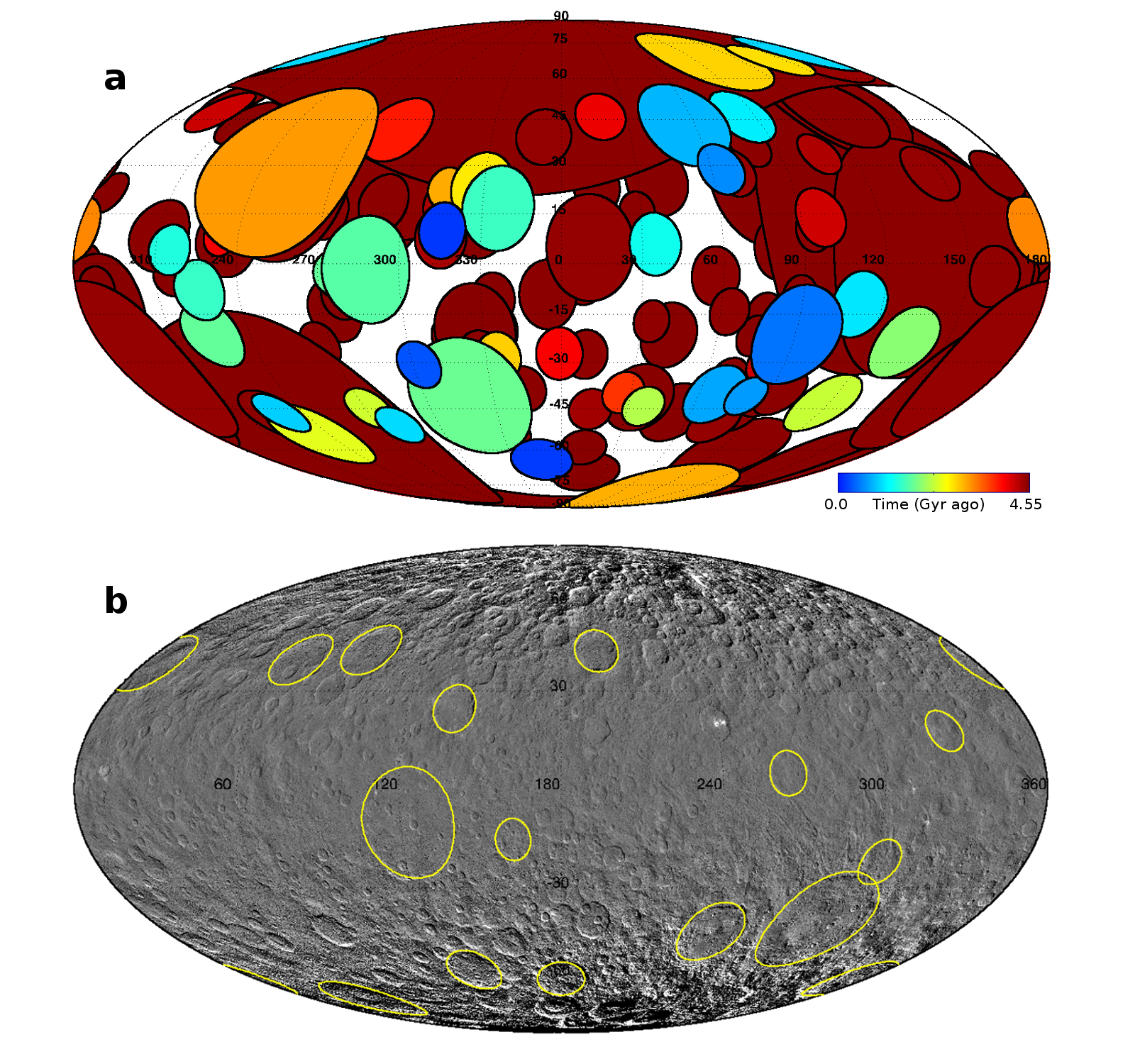
Figure 1. (a) Mollweide projection of all impact craters >100 km (~170) expected to have formed since 4.55 Gyr ago. The picture shows a representative Monte Carlo simulation for the nominal model. Colour code provides epoch of formation. While old craters are obliterated by subsequent cratering, empirical saturation shows that some 40 craters >100 km should be retained. (b) Mollweide projection of a Ceres global mosaic showing observed 16 confirmed craters >100 km (yellow lines).
On the other hand, there is growing evidence that Ceres was hit by a very large asteroid. This evidence comes from the overall flatness of the topography over large scales implying that the dwarf planet's surface is relatively smooth. Good examples are the smooth terrains near the 280-km diameter Kerwan, the largest well-defined impact structure, which extends from East to West for about 1,000 km. Intriguingly, by looking carefully at the global topography we found a very degraded 800-km-wide depression that could be a relict impact structure (Figure 2). While we cannot be sure about the true origin of this feature, this would be compatible with the collisional models. And extrapolating from one such enormous impact structure, many more of smaller diameters are expected, as indicated above. Thus, let's for now assume that a significant population of large cerean impact craters did form. What happened to them? Is it possible that their scars were healed beyond recognition over the eons?
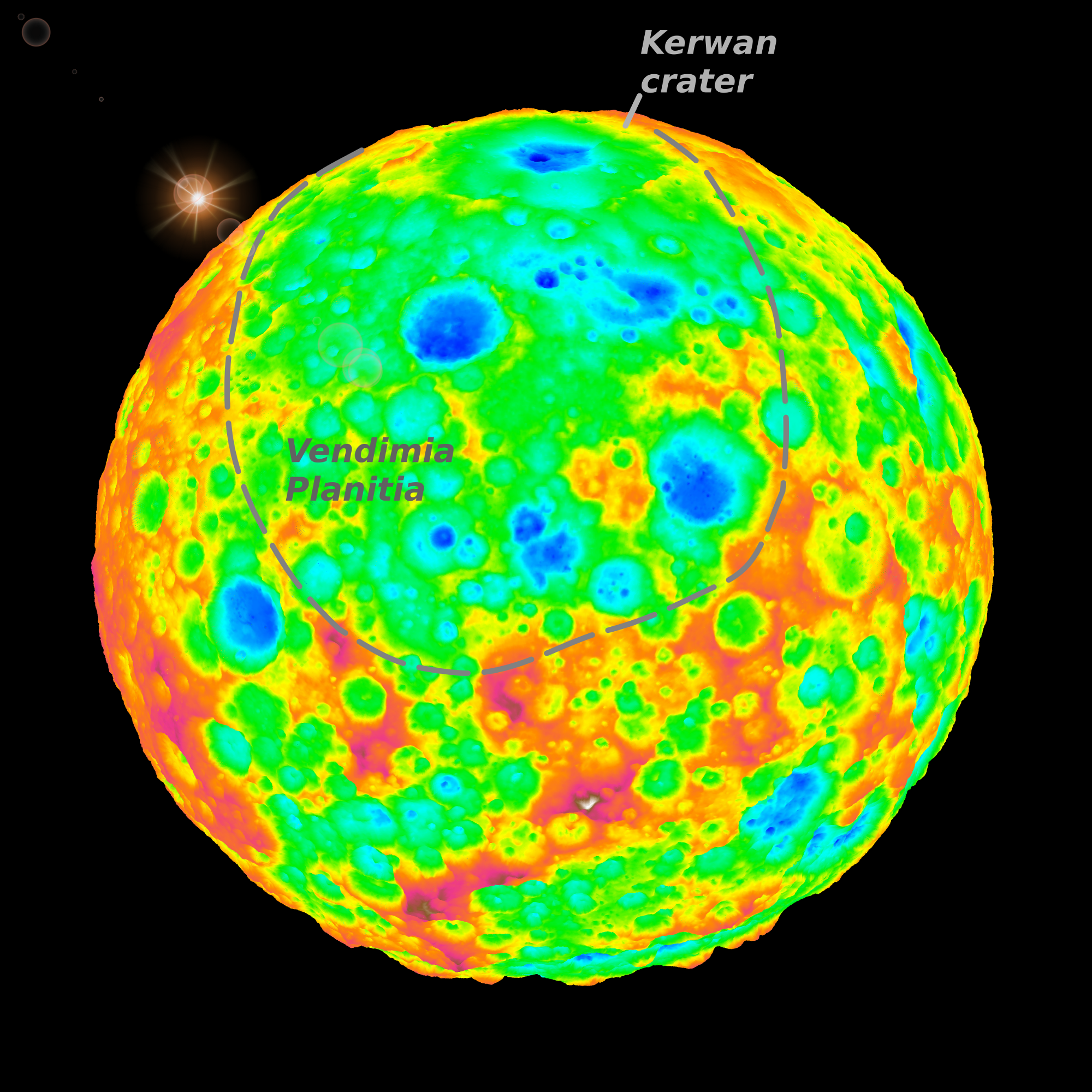
Figure 2. The top of this false-color image includes a grazing view of Kerwan, Ceres’ largest impact crater. This well-preserved crater is 280 km wide and is well defined with red-yellow high-elevation rims and a deep central depression shown in blue. Kerwan gradually degrades as one moves toward the center of the image into an 800-km wide, 4-km deep depression (in green) called Vendimia Planitia. This depression is possibly what’s left of one of the largest craters from Ceres’ earliest collisional history (click on image for higher resolution).
Figure 3. The animation shows both visible (left) and topographic (right) mapping data from Dawn (click here to enlarge in a new page).
No matter how odd this may seem, the answer is yes, it is possible. Dawn is gathering evidence of the presence of a significant amount of water ice (20-30%) in Ceres' subsurface. Ice is known to be mobile under the right temperature conditions, and therefore can deform in such a way to fill in depressions such as deep, fresh craters (although there are differences, think of a terrestrial glacier as an example). The presence of weak materials such as clays, and antifreeze like salts and ammonia can also enhance landscape deformation. Over a long time scale (hundreds of millions of years to billions of years) these processes could remove large craters. Alternatively, it is possible that Ceres was an active body in the past, characterized by the presence of cryo-volcanoes (that is, ice volcanoes). This is partially supported by the presence of intriguing massive carbonate deposits at the surface and a 4-km tall isolated mountain. Cryo-volcanoes could have erupted low-viscosity materials potentially capable of burying pre-existing impact structures. At this stage, we don't know which one of the processes above is more likely responsible for the flat topography and lack of large craters. It is even possible that there may be additional processes that we have not thought of yet. Regardless, the emerging picture is one in which Ceres' peculiar internal structure and composition is responsible for shaping its surface and its cratering record. All of this is way more intriguing than many of us had anticipated.
This research was published in the July 26th 2016 issue of Nature Communications (here).